“Should we use Kimball, Inmon or Data Vault?” The question comes up in projects, at conferences and on LinkedIn. The discussions that follow often sound like an election campaign. Every school has its loyal voters, its slogans and its well-rehearsed attacks on the others. Nobody campaigns on “more maintenance and another steering committee,” although both tend to make it into the final coalition agreement.
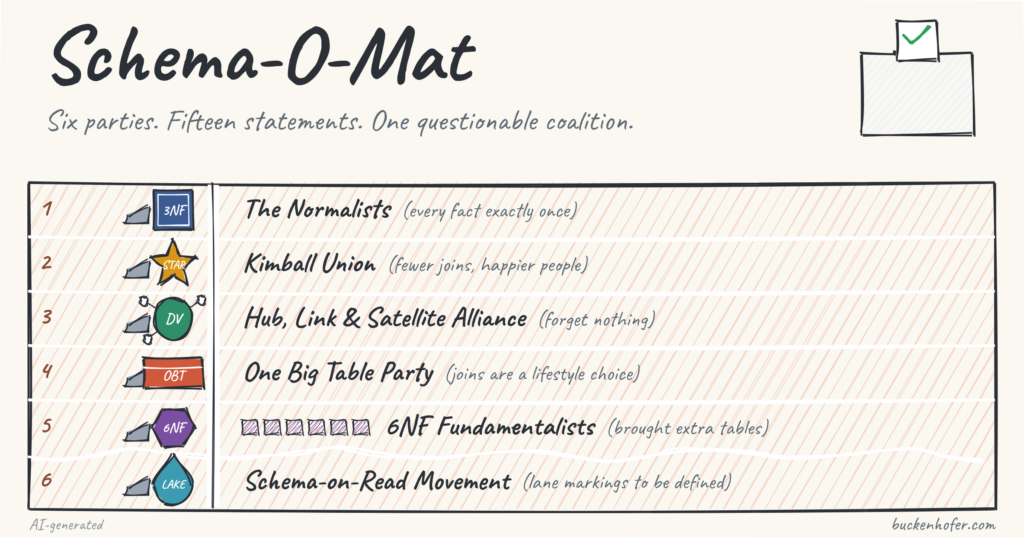
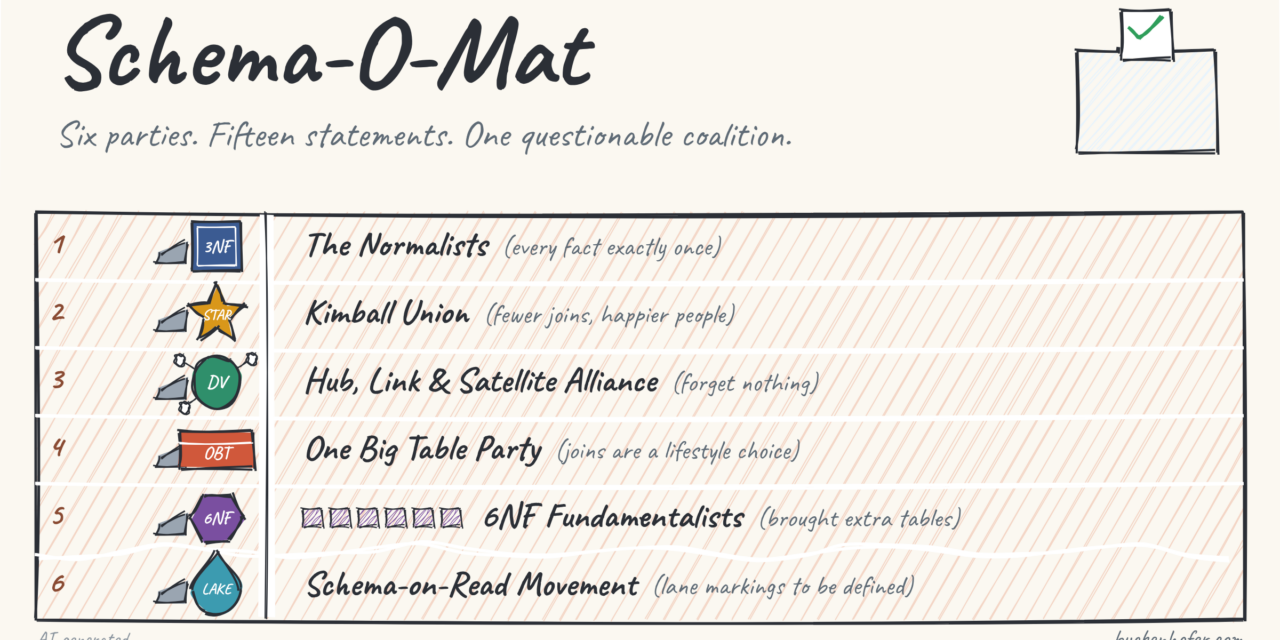
So it seemed only fair to settle the Kimball vs Inmon vs Data Vault debate with an election. The Schema-O-Mat lets six parties compete for your vote:
- the Normalists (3NF),
- the Kimball Union (star schema),
- the Hub, Link & Satellite Alliance (Data Vault),
- the One Big Table Party,
- the 6NF Fundamentalists (Anchor Modeling),
- the Schema-on-Read Movement.
The method is borrowed from voting advice apps, the campaign promises from vendor slide decks. You take a stand on 15 statements, mark the ones that matter most to your project, and the tool calculates which party represents you best. The statements are phrased with a wink, but each of them hides a real requirement, for example whether business users write their own queries, whether every change in every source has to be auditable, or what happens when a source system renames a column on a Friday afternoon. On the result page you can compare your answers with the party positions and read what lies behind each campaign promise.
Why there is no single winner
The election metaphor has a flaw, and I built it in on purpose. In most data platforms these approaches do not compete for the same job, because an integration layer and a consumption layer have different priorities. A Data Vault or a normalized model is good at integrating many sources and keeping their history, but hardly anyone wants to query it directly. A star schema or a set of wide tables is easy to consume, but reaches its limits once ten source systems have to be integrated and every change must remain traceable. This is why the Schema-O-Mat does not stop at naming a winner. It suggests a coalition that combines both roles, because the more useful question is which method fits which job and what it needs alongside it. That question makes a poor campaign slogan, but it leads to better architectures.
The coalition logic contains a second joke that is closer to reality than I would like. Your winning party picks its partner by a time-honored political principle, namely whoever agrees with you the loudest, which in practice is your second-favorite party. A Data Vault winner usually ends up with the 6NF Fundamentalists, who share its enthusiasm for history and bring a few more tables. The reality check then proposes a complementary partner from a curated shortlist, in this case a star schema or wide tables for consumption. Sometimes your preferred coalition already fits that pattern, and sometimes it combines the same blind spot twice. Teams make similar choices when they pick an approach because it confirms what they already believe rather than because it addresses a requirement. Agreement makes meetings easier, but it does not make architectures better.
Cast your vote
The Schema-O-Mat takes about three minutes. The party positions are deliberately simplified, and you will probably disagree with at least one of them. If you do, I would like to hear which statement or position you would change and why. You can copy your result from the result page and share it on LinkedIn, and coalition negotiations in the comments are welcome.