In AI and data programs, a surprising amount of friction doesn’t come from technology – it comes from language. Terms like data strategy, data governance, data management, security, privacy, and compliance are often used interchangeably, even though they answer different questions, imply different responsibilities, and produce different outcomes. The result is predictable: meetings where everyone agrees, but no one means the same thing – and initiatives that build a lot of “plumbing” without a shared understanding of why, for whom, and under which rules.
This article is not another tooling comparison or a “best stack” debate. It’s about clarity – because Use Cases First only works when we can separate concerns cleanly: What is the goal (Data Strategy)? Who decides (Data Governance)? Who executes (Data Management)? How do we protect people and assets (Privacy and Security)? And how do we prove we follow the rules (Compliance)?
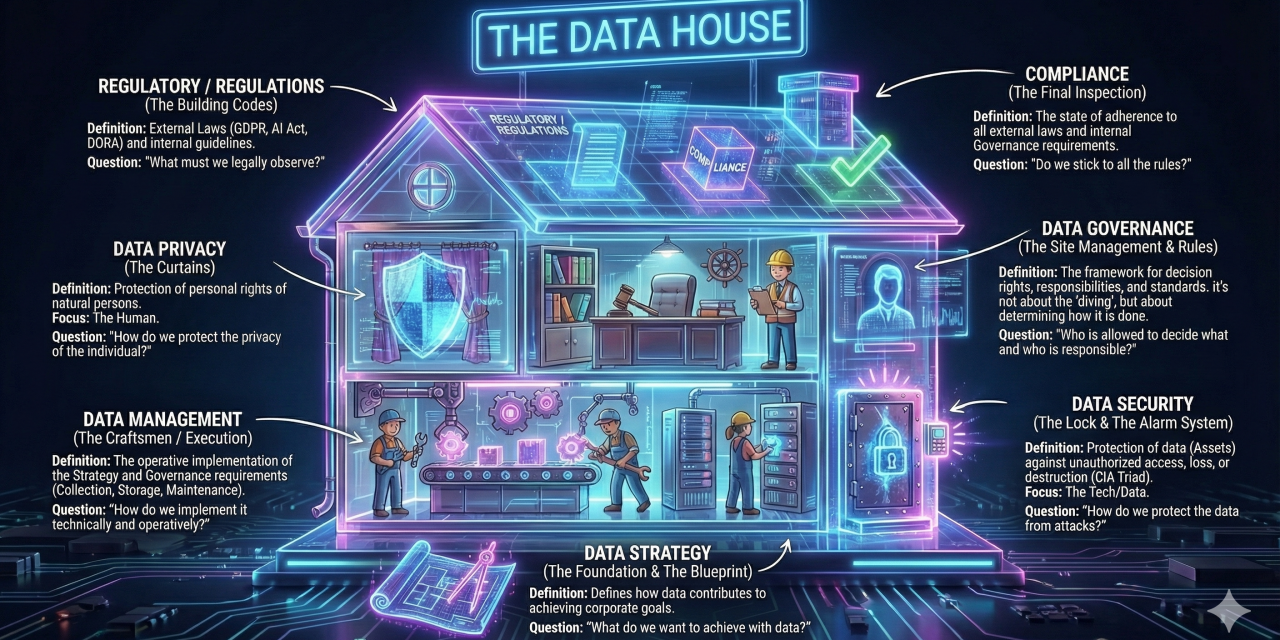
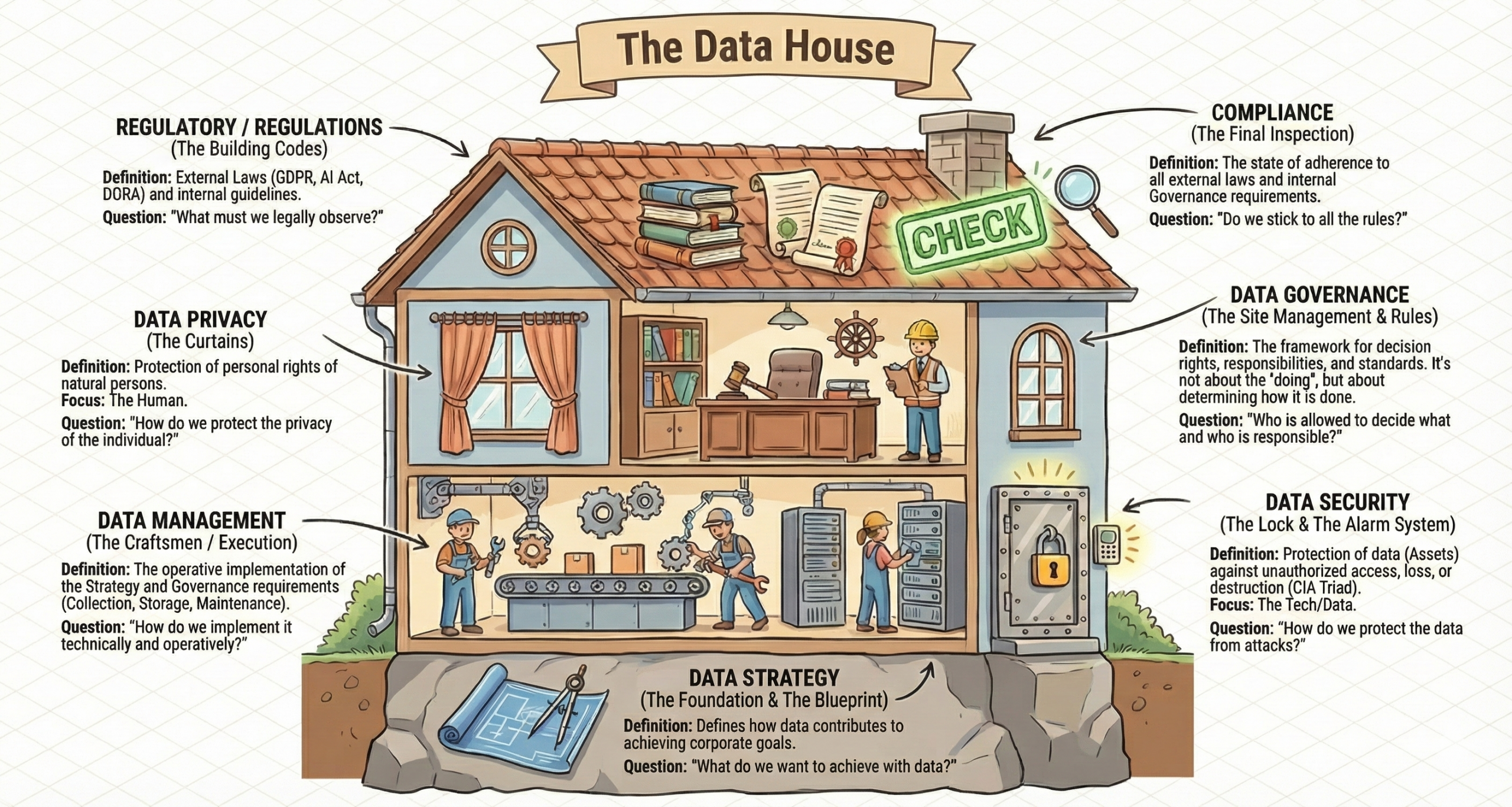
To make these distinctions intuitive, I use a metaphor: The Data House. Like a real building, every element has a clear purpose. The foundation carries the weight (Strategy). Building codes define constraints (Regulations). The structural framework and site management define decision rights (Governance). The craftsmen do the work (Data Management). Curtains and locks protect what’s inside (Privacy and Security). And in the end, an inspector verifies adherence (Compliance). The metaphor is intentionally pragmatic: it helps untangle conversations, align stakeholders, and make trade-offs explicit.
By the end, you’ll have a practical blueprint you can use in workshops, roadmaps, and architecture reviews – so that statements like “we need more governance” turn into concrete decisions: Which rule, for which use case, decided by whom, implemented how, and evidenced where?
The Data House
It’s a metaphor to explain how Data Strategy, Regulations, Data Governance, Data Management, Privacy, Security, and Compliance interlock to implement use cases that deliver value – safely.
The Data House in one sentence
A valuable data platform is not “a lakehouse + pipelines.”
It’s a structure where:
-
Data Strategy defines why
-
Regulations define boundaries
-
Data Governance defines who decides and which policies
-
Data Management defines how we execute
-
Privacy & Security define how we protect
-
Compliance defines how we prove it
The Foundation: Data Strategy
Question: What do we want to achieve?
Every stable structure needs a foundation. In the Data House, the foundation is Data Strategy.
A good strategy clarifies:
-
the business outcomes we optimize for,
-
what we will not do,
-
the metrics that define “success,”
-
and whether we’re playing Offense (growth, innovation, AI) or Defense (risk, compliance, resilience).
Architect’s perspective:
Don’t start building pipelines until the business goal is clear. Strategy is the blueprint. If the foundation is vague, the architecture will crack under pressure – usually when costs rise or the first audit arrives. BTW, don’t forget to humanize data strategy as “Culture eats strategy for breakfast“.
The Ground: Regulatory Landscape
Question: What must we legally observe?
You can’t build a house anywhere. You build within zoning laws and building codes. In data, that’s the Regulatory Landscape.
These are external constraints you don’t get to negotiate:
-
GDPR (personal data and rights)
-
AI Act (risk-based requirements for certain AI use cases)
-
DORA (operational resilience in finance)
-
Data Act (access and sharing requirements)
-
And further laws plus internal policies and industry standards
Architect’s perspective:
Treat regulations as non-functional requirements – not blockers. Just like fire exits are part of building design, compliance capabilities must be built into the architecture.
The Structure: Data Governance
Question: Who creates the rules – and who decides?
This is where many teams blur “doing” and “deciding.” In the Data House, Data Governance is the site management and structural framework.
Governance defines:
-
decision rights,
-
accountability,
-
definitions, standards and conceptual models (e.g., “What is a customer?”, How to calculate marginal return KPI?),
- overall data architecture
-
and how conflicts are resolved.
In modern models (e.g., Data Mesh), governance shifts from a central bottleneck to a federated approach (“Data Mesh”) – but the core principle remains:
Data autonomy, not anarchy.
Teams should move fast, but with just enough standards to stay interoperable.
Architect’s perspective:
Governance is structural integrity. Without it, even excellent execution produces silos, conflicting metrics, and distrust.
The Interior: Data Management
Question: How do we execute?
If Governance defines the rules, Data Management is the operational execution: the craftsmen.
It includes:
-
data product design and implementation,
-
storage and data lifecycle management (generation, ingest, transformation, retrieval, retention, archival, deletion),
- physical data modeling,
-
access enablement for products and analytics,
-
reliability practices (SLAs/SLOs, incident response)
A crucial distinction:
Governance sets policy (e.g., “Customer data must be retained for 10 years”).
Data Management implements it (e.g., retention configuration, deletion workflows, audit logs).
Architect’s perspective:
Most “data pain” is management pain: reliability, costs, and operational ownership. Make it explicit – don’t hide it behind tech terms.
The Protection: Privacy vs. Security
A common confusion is treating Privacy and Security as synonyms. They’re not.
The Curtains: Data Privacy
Question: How do we protect the individual?
Privacy is about people and their rights. It’s the “curtains” of the house: limiting visibility and protecting the inhabitants. While the GDPR provides the strict regulatory framework for these controls in EU, privacy itself is the broader ethical commitment to respecting the dignity and boundaries of the people living behind those curtains.
Typical controls:
-
data minimization (collect less)
-
purpose limitation (use for what was agreed)
-
anonymization/pseudonymization
-
consent handling, DSAR (data subject access request) support
-
privacy-by-design in models and products
The Lock: Data Security
Question: How do we protect the asset?
Security is about protecting data against theft, loss, and unauthorized access – often described by the CIA triad (Confidentiality, Integrity, Availability).
Typical controls:
-
IAM and least privilege
-
encryption at rest/in transit
-
secrets management
-
monitoring, detection, incident response
-
DevSecOps / shift-left practices
Architect’s perspective:
You can have a secure house (strong locks) that still violates privacy (transparent walls). You need both.
The Inspection: Compliance
Question: Do we stick to the rules – and can we prove it?
Finally, Compliance is the building inspector.
Compliance is not a pillar itself – it’s the state of adherence:
-
Did we follow the blueprint (Strategy)?
-
Did we respect building codes (Regulatory)?
-
Did we follow the rules (Governance)?
-
Did we implement them correctly (Management)?
-
Are protection controls real and measurable (Privacy/Security)?
Architect’s perspective:
If Compliance is treated as bureaucracy, teams will route around it.
If it’s treated as evidence and automation, it becomes scalable – and much less painful.
A quick example: “Use Case First” in the Data House
Let’s make it concrete with an example use case: Reduce customer churn by 10% in 6 months using early warning signals and targeted retention offers.
The picture shows a possible configuration of the (Data House) Use Case canvas for this specific data product. It demonstrates how to translate abstract concepts like ‘Data Governance’ or ‘Compliance’ into tangible product requirements, creating a clear ‘one-page alignment tool’ that aligns stakeholders from day one.
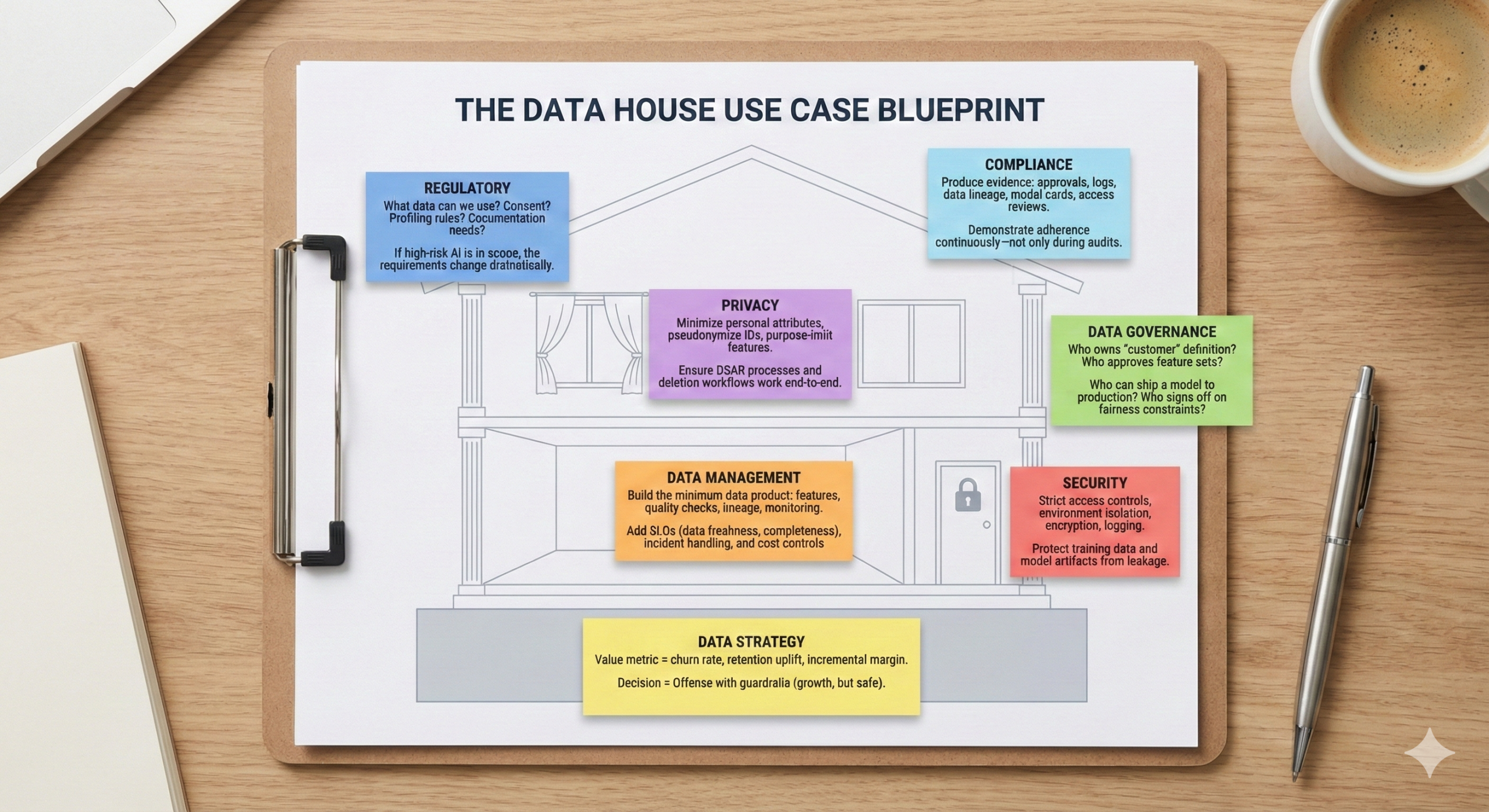
That’s “use case first”: not “build a platform and hope for value,” but “build the minimum architecture needed to deliver this outcome safely.”
If you want a practical way to apply this with stakeholders, follow this blueprint:
-
Use case & value
What outcome? What KPI? What time horizon? What’s “done”? -
Data boundaries
What data is required vs. “nice to have”? What is legally/ethically sensitive? -
Decision rights
Who decides definitions, access, and release criteria? Who owns the product? -
Minimum data product & operations
What’s the smallest pipeline/product that can deliver value with reliability?
Define SLOs and “cost guardrails.” -
Controls & evidence
What privacy/security controls are required? What evidence will you automate?
Result: a blueprint that connects value, execution, and proof – without drowning in tooling debates.
Recap
The tech stack is raraly the cause for misunderstandings or failures in AI and data projects. The Data House metaphor helps to show the differences in various fields that belong to AI and data projects but are often confused:
-
Foundation: Data Strategy (business alignment)
-
Ground: Regulations (legal boundaries)
-
Structure: Data Governance (roles & rules)
-
Interior: Data Management (execution and operations)
-
Protection: Privacy (curtains) & Security (locks)
-
Inspection: Compliance (evidence of adherence)
Balanced correctly, this structure supports a Use Cases First approach – turning data from a cost center into a real business asset.
If you want to apply the above mentioned blueprint: pick one high-value use case and run through the topics in a time-boxed approach. Be pragmatic – and a much better chance of delivering value without building a swamp.



Really interesting way of breaking down the “Data House” concept into strategy, governance, management, and security layers. In many organizations these responsibilities often get mixed together, which makes it difficult to clearly define ownership and accountability across the data lifecycle.
In one environment we worked with, separating governance policies from operational data management helped teams focus more effectively on both compliance and value creation. It also made it easier to align data initiatives with real business use cases rather than purely technical goals.
Curious how organizations practically maintain this separation between strategy, governance, and operational management as data platforms become more integrated and AI-driven?
Thanks for the question, Sam. The short answer: separation doesn’t mean isolation – it means clarity of intent at each layer, even when the tooling converges. Three things that help in practice:
Contracts over committees – machine-readable data contracts that encode ownership, SLOs, and access policies make governance enforceable, not just advisory.
Federated ownership with centralized guardrails – domain teams own their data products, but naming conventions, classification standards, and lineage requirements stay centrally defined. Local freedom, non-negotiable fire exits.
Automation as the glue – policy-as-code, automated tagging, CI/CD-enforced schema checks. When compliance evidence is a byproduct of the pipeline, separation sustains itself without manual overhead.
The Data House metaphor applies here too: prefab modules don’t eliminate the distinction between structure and interior – they just make execution more efficient.